 KELIBRON
 Course · 2 of 7 lessons available
Measurement basics
Seven lessons on what makes a measurement count before you pick up any instrument: units and traceability, the words metrologists use, measuring methods, sizes and tolerances on a drawing, measuring conditions, and how to record a reading. As each lesson goes live it pairs a guide, a demonstration and practice in the lab.
For students, apprentices and anyone new to measuring. No prior knowledge needed; a good start before the caliper course.
Lessons
- Length units and traceability
- Measurement terms
- Measuring methods Coming soon
- Sizes and tolerances on a drawing Coming soon
- Measuring conditions Coming soon
- Recording a reading Coming soon
- Length measurement in the physics lab Coming soon
Lesson 1
Length units and traceability
Convert between metric and inch units and explain what makes a reading traceable.
You will be able to
- Convert between mm, µm and inches (1 in = 25.4 mm exactly).
- Say how the metre is defined.
- Describe the chain of calibrations that links a workshop gauge to the metre.
Learn this lesson in the lab → Read the guide: Length units and traceability
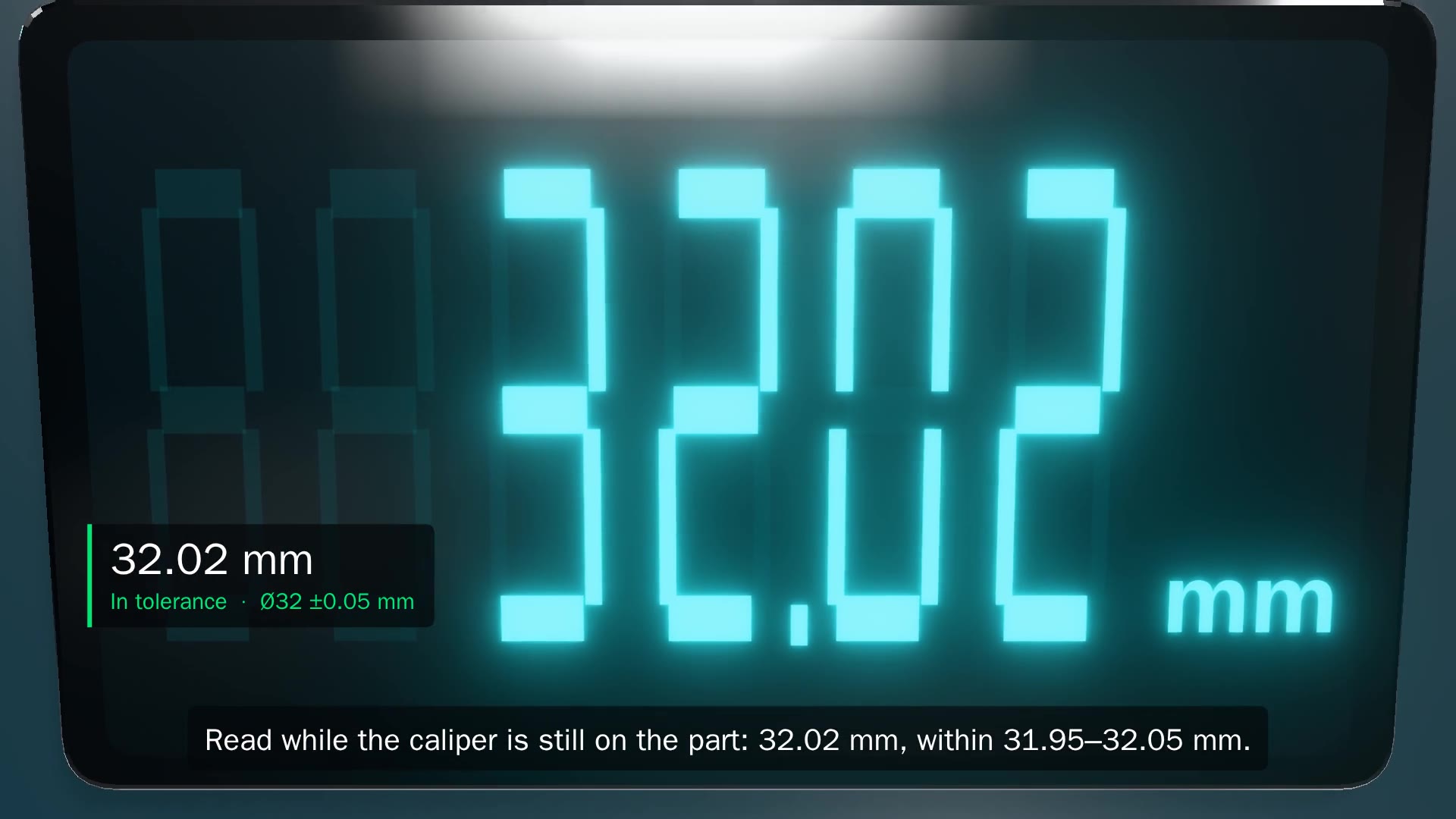 Watch the demonstration · 0:28
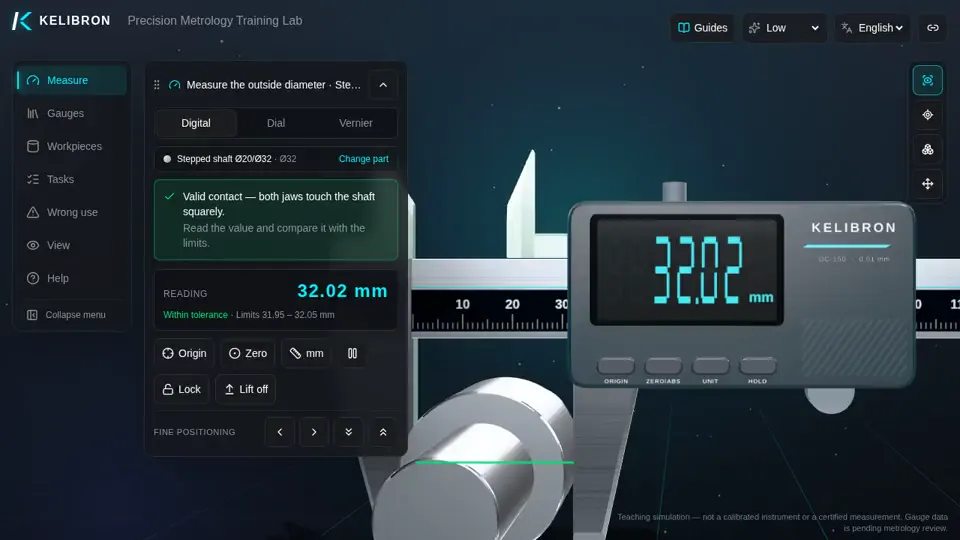
Practise in the lab
Lesson 2
Measurement terms
Use the basic terms of measurement correctly.
You will be able to
- Tell resolution from scale interval.
- Tell error of indication from maximum permissible error.
- Tell calibration from verification.
Learn this lesson in the lab → Read the guide: Measurement terms in English and Chinese
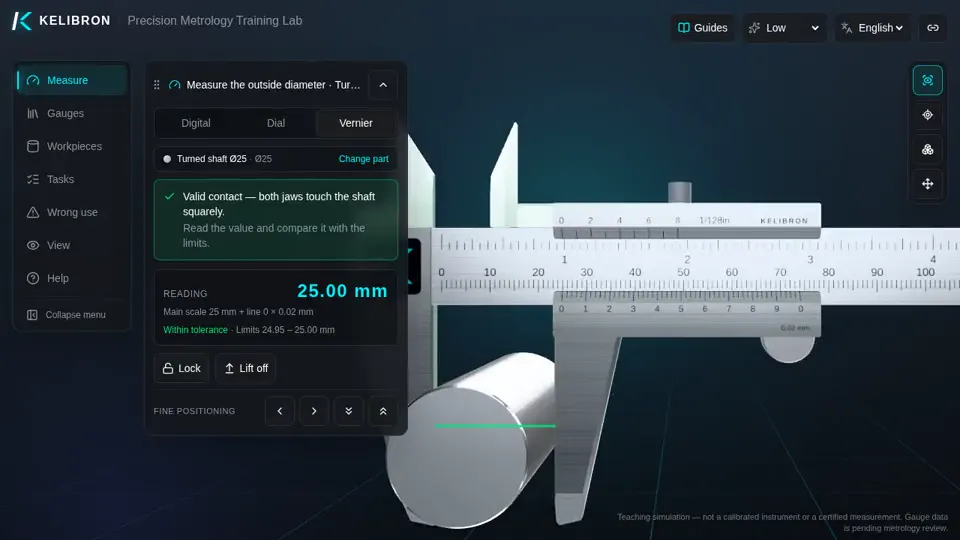
Practise in the lab
Lesson 3 · Coming soon
Measuring methods
Recognise the main kinds of measurement and when each is used.
You will be able to
- Tell a direct measurement from an indirect one.
- Tell an absolute measurement from a comparison against a standard.
- Name the method behind a given reading.
Lesson 4 · Coming soon
Sizes and tolerances on a drawing
Read a size and its tolerance from a drawing.
You will be able to
- Find the nominal size and its limit deviations.
- Work out the upper and lower limits of size.
- Recognise general tolerances that apply when none is written.
Lesson 5 · Coming soon
Measuring conditions
Prepare the part, the instrument and the place before measuring.
You will be able to
- Explain why sizes refer to 20 °C.
- Clean the part and the measuring faces.
- Use a light, steady measuring force.
Lesson 6 · Coming soon
Recording a reading
Write a reading with the right number of digits and its unit.
You will be able to
- Record a reading to the instrument's resolution, or as the lab handout asks in a physics practical.
- Round a value by the rules.
- Write the unit and note the instrument used.
Lesson 7 · Coming soon
Length measurement in the physics lab
Do the school physics length-measurement practical correctly.
You will be able to
- Read a vernier caliper and correct its zero error.
- Measure an inside diameter and a depth.
- Record repeated readings with their unit.