 KELIBRON
 Reading calipers
How to read a dial caliper
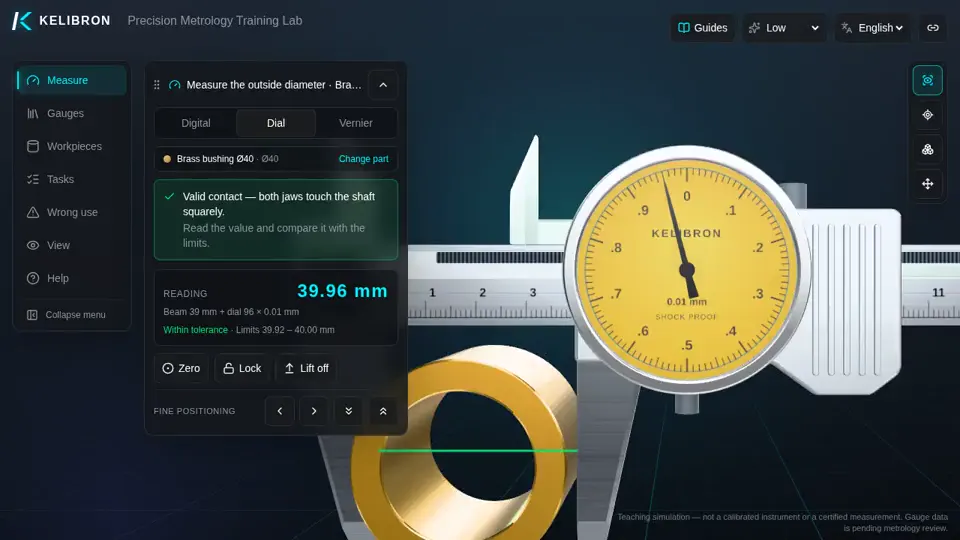
Reading = millimetres on the beam scale (at the slider’s reading edge) + needle divisions × 0.01 mm. On a typical metric dial caliper one revolution is 1 mm, split into 100 divisions.
On this page
Reading
- Read the whole millimetres on the beam scale at the slider’s reading edge.
- Read the needle on the dial in hundredths (each division 0.01 mm).
- Add them. Example: 28 mm + 3 divisions = 28.03 mm.
Check that the beam reading and the needle agree: when the needle passes 0 the beam reading must step to the next millimetre. Some dials turn 2 mm per revolution or read 0.02 mm; read the value printed on the dial.
Setting zero with the bezel
Clean and close the jaws, loosen the bezel lock, turn the bezel until 0 sits under the needle, and lock it again. Set the bezel only with the jaws closed. It corrects the hundredths only: if the beam reading is off by a whole millimetre, the rack has jumped a tooth and the caliper needs repair.
Care
Do not drop a dial caliper or let the slider slam shut: the rack and pinion can jump a tooth and the zero is lost. Keep the rack clean of chips; store with the jaws slightly open.
References
- ISO 13385-1:2019 — Geometrical product specifications (GPS) — Dimensional measuring equipment — Part 1: Design and metrological characteristics of callipers · ISO
- JJG 30-2012《通用卡尺》检定规程 (cited by number; no public page) · 国家质量监督检验检疫总局
Watch it done
Played back in the lab from domain commands; the reading and verdict come from the measurement model.
Practise in the lab

Questions
How many millimetres is one revolution of a dial caliper?
Usually 1 mm (100 divisions of 0.01 mm); some models use 2 mm per revolution.
Is a dial caliper more accurate than a vernier caliper?
Not necessarily. A 0.01 mm dial reads finer than a 0.02 mm vernier, but the accuracy of both 150 mm calipers is of the same order; the dial is quicker and easier to read.
Try it yourself
Open the same setup in the 3D lab and take the reading yourself.
Related guides
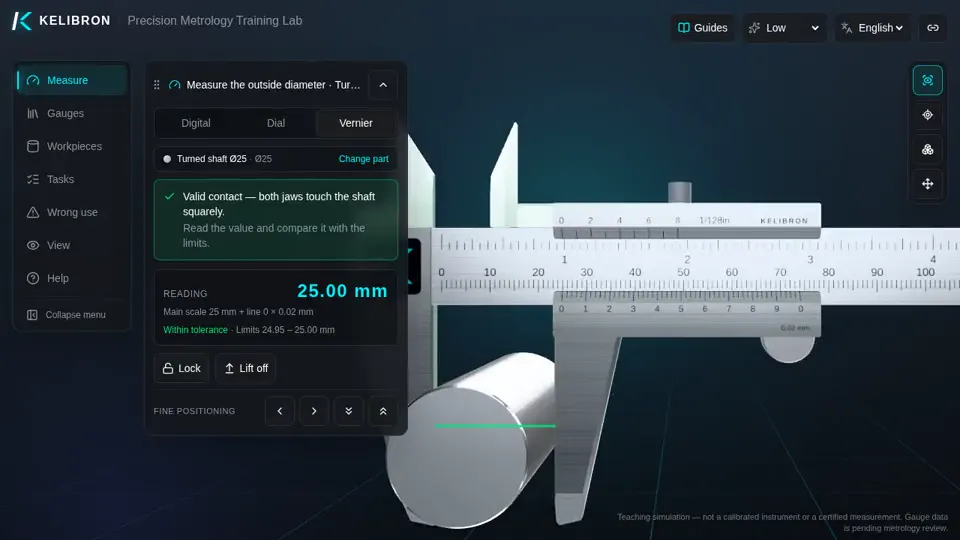 Reading calipersHow to read and use a caliperCheck zero with the jaws closed, hold the part deep in the jaws and square to the beam, close with light, even force, then read: on a vernier, the main-scale millimetres plus the coinciding line × 0.02 mm; on a dial, millimetres plus the needle’s hundredths; on a digital caliper, the display.
- Reading calipersHow to read a vernier caliperReading = whole millimetres on the main scale (left of the vernier zero) + number of the vernier line that lines up × least count.
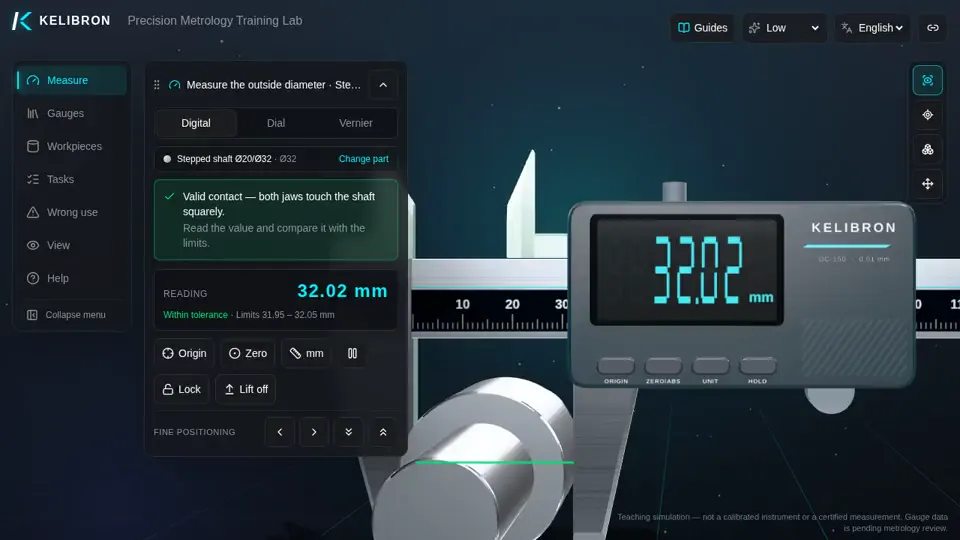 Reading calipersHow to use a digital caliperA digital caliper shows the value directly, usually to 0.01 mm.