 KELIBRON
 KELIBRON guides
Learn to measure with calipers
Short, exact guides to reading calipers, measuring real parts, judging tolerances and caring for instruments. Every guide opens a matching exercise in the free 3D lab.
Browse by topic
Reading calipers
How vernier, dial and digital calipers are read, with worked examples — the place to start.
Measuring methods
Outside, bore, depth, steps and centre distances on real parts, and the mistakes that spoil a reading.
Tolerances and decisions
Limits and fits, choosing an instrument for the tolerance, and how uncertainty affects pass or fail.
Instrument care
Daily checks, calibration with gauge blocks, registers, labels and records.
Teaching and certification
Using the lab in class and in company training, and what practical assessments check.
Beginner’s path
Try it in the lab
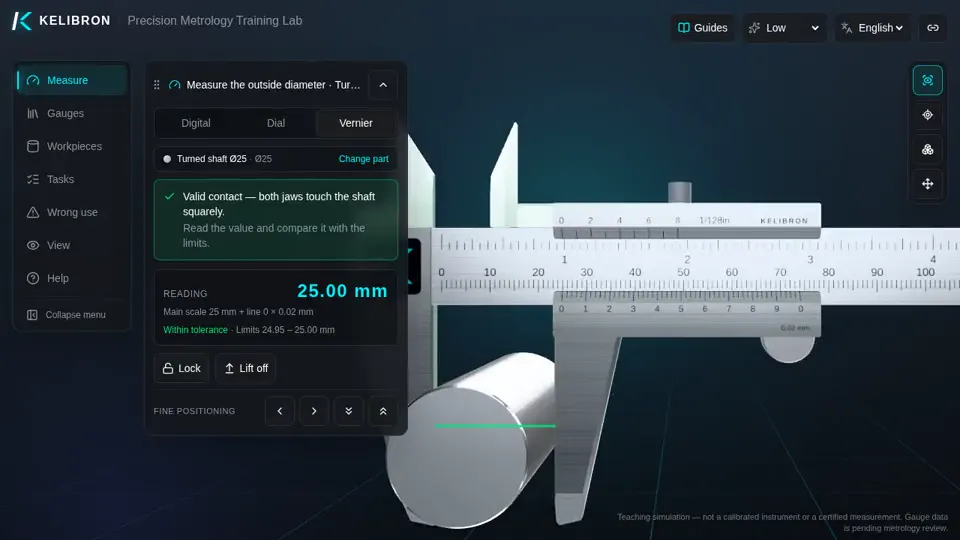 Vernier caliperRead a vernier caliper on a Ø25 shaft (readout view)Open in the lab →
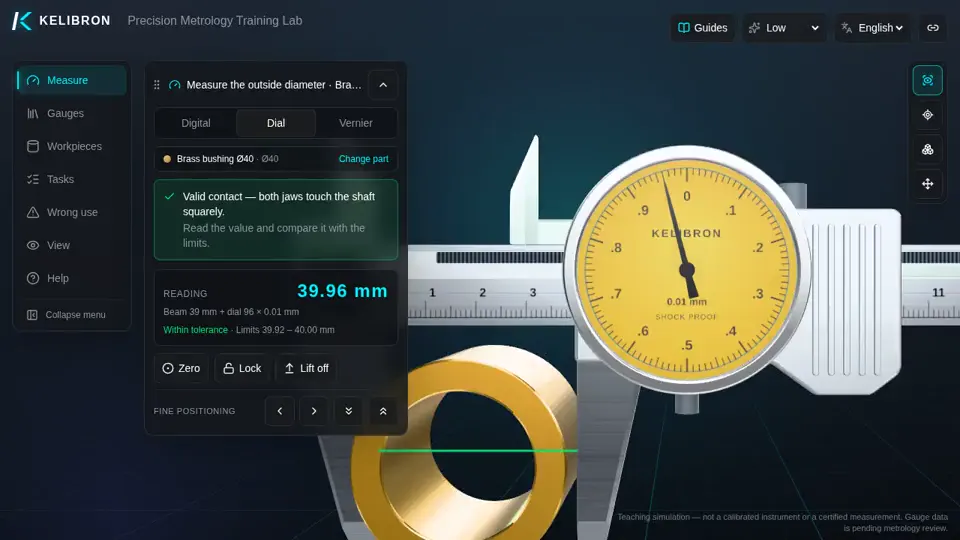 Dial caliperRead a dial caliper on a bushing (readout view)Open in the lab →
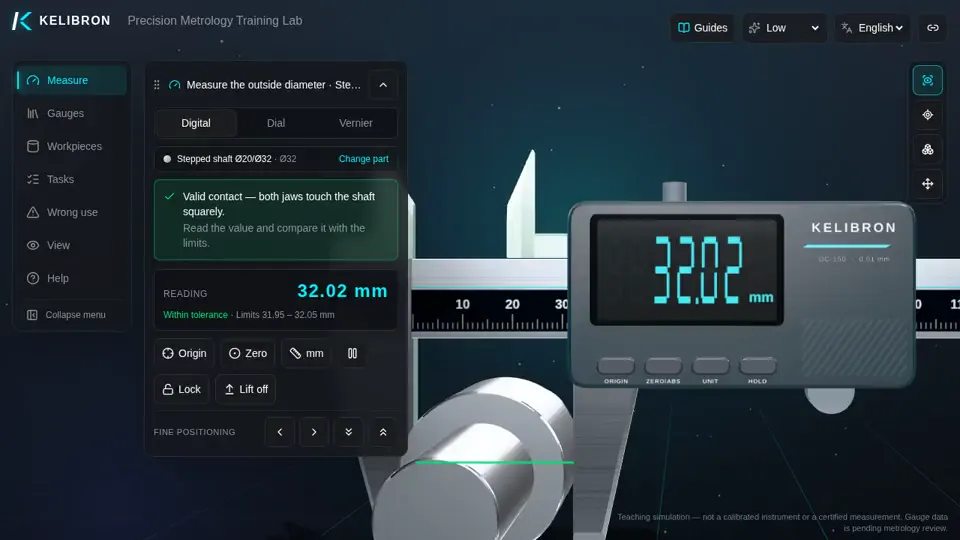 Digital caliperDigital caliper on a stepped shaft (readout view)Open in the lab →
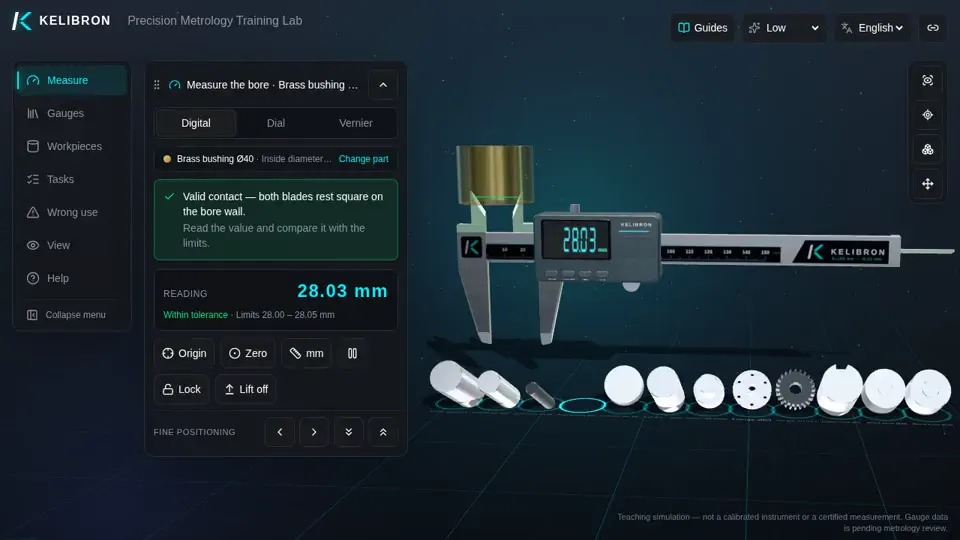 Digital caliperMeasure the bore of a bushingOpen in the lab →
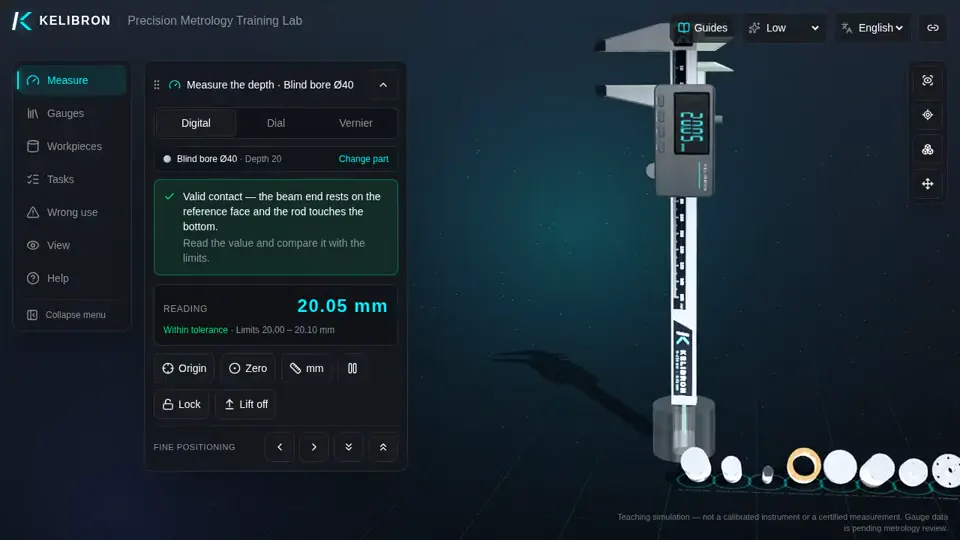 Digital caliperMeasure the depth of a blind boreOpen in the lab →
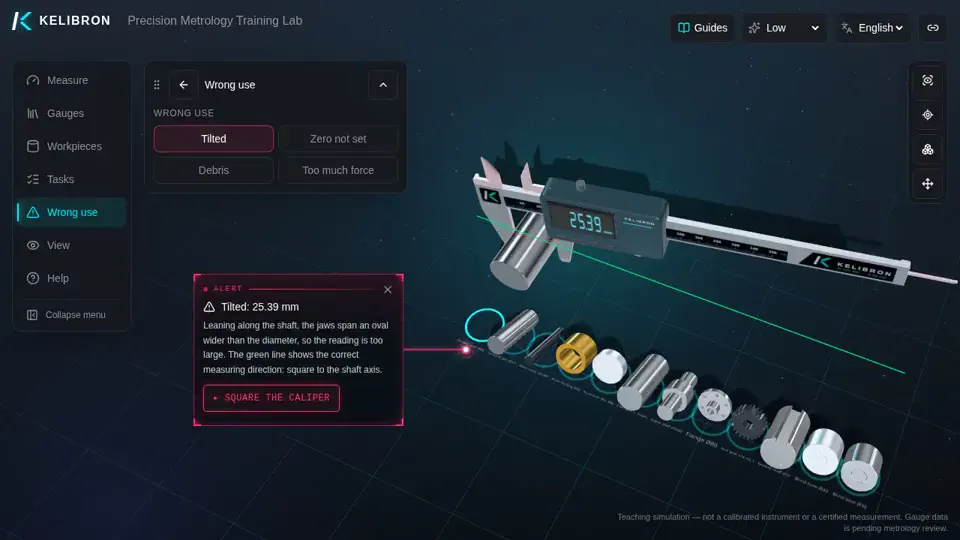 Digital caliper · wrong useWrong use: caliper tilted on a shaftOpen in the lab →
About the lab
Is KELIBRON free?
Yes. It runs in any modern browser with WebGL, without installation or an account.
Which calipers can I practise with?
A digital caliper (0.01 mm, ORIGIN, ZERO/ABS, UNIT, HOLD), a dial caliper (0.01 mm, 1 mm per revolution) and a vernier caliper (0.02 mm, with a 1/128 in inch vernier), each 0–150 mm.
What can I measure?
Outside diameters (also on a stepped shaft, a flange, a gear and a keyed shaft), bores with the inside jaws, and blind-bore depths with the depth rod. Some parts are made out of tolerance on purpose.
Does it work on phones and tablets?
Yes: the layout adapts to phones in portrait and landscape; long-press shows part explanations.
Can I share a setup with students?
Yes. The share button copies a link that reopens the same caliper, part, task and pose; it opens in the viewer’s own language.
Which languages are available?
English and Simplified Chinese.