 KELIBRON
Measuring methods
Thread micrometer
A flat-anvil micrometer closes on thread crests, not the pitch diameter. Start by distinguishing that crest reading from a thread-micrometer or three-wire measurement; none of those single readings replaces both GO and NO-GO checks. The M20×2.5 example below shows where the ordinary anvils touch.
On this page
What does a flat anvil actually touch?
On an M20×2.5 stud, a 0–25 mm outside micrometer with flat anvils closes on the crests. That number sits near the major diameter. It is not the pitch diameter.
Pitch diameter is the imaginary cylinder where thread thickness equals groove width. The thread basics page sets out that distinction. A crest reading does not land on it.
Why is this not a thread-gauge result?
A thread gauge still has to complete both the GO and NO-GO checks. One outside reading, flat anvil or otherwise, does not make those two checks.
The three-wire method is a third route: the micrometer reads measurement over wires, and pitch diameter is calculated. Do not copy that formula onto a flat-anvil reading.
Which standard is current?
The current Chinese standard is GB/T 10932-2024. It was issued on 25 April 2024, took effect on 1 November 2024, and replaced GB/T 10932-2004. The 1989 edition is also withdrawn.
Face geometry, graduation, range and maximum permissible error sit in the standard text. Those clauses were not opened, so they are not restated here.
What can you practise in KELIBRON?
KELIBRON’s public gauge library has no thread micrometer. The ordinary outside micrometer exercise only trains light, aligned contact of flat faces.
Do not treat a flat-anvil reading on a threaded part as pitch diameter, and do not treat it as a gauge pass.
References
- GB/T 10932-2024《螺纹千分尺》 · 国家市场监督管理总局、国家标准化管理委员会
How the guides are checked against these sources: About KELIBRON.
Practise the shared basics on a caliper
Questions
Which standard covers a thread micrometer?
GB/T 10932-2024 is current. It took effect on 1 November 2024 and replaced the 2004 edition.
Can I measure M20×2.5 pitch diameter with a flat-anvil micrometer?
No. Flat anvils close on the crests, and that reading is not pitch diameter.
Does a thread micrometer replace a thread ring gauge?
No. GO and NO-GO checks are a separate attribute inspection. One outside reading does not make both checks.
Practise the basics first
Cleaning, zero checks, square positioning, light even force and reading to the scale interval are the same on every instrument; practise them in a caliper scene.
Related guides
- Measuring methodsThree-wire methodFor the symmetrical 60° parallel external thread covered here, seat three suitable equal-diameter wires on the flanks, measure over them with a micrometer, then calculate pitch diameter from that measurement and the calibrated wire diameter.
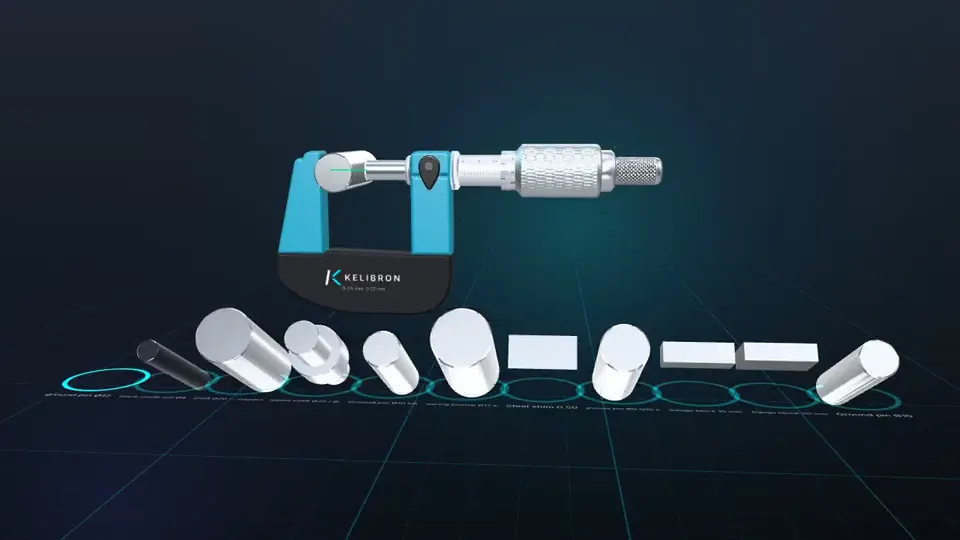 Reading instrumentsMicrometer zero check and zero error correctionCheck a micrometer against its reference before measuring: close the clean faces with the ratchet on a 0–25 mm model, or use the matching setting standard on larger ranges.
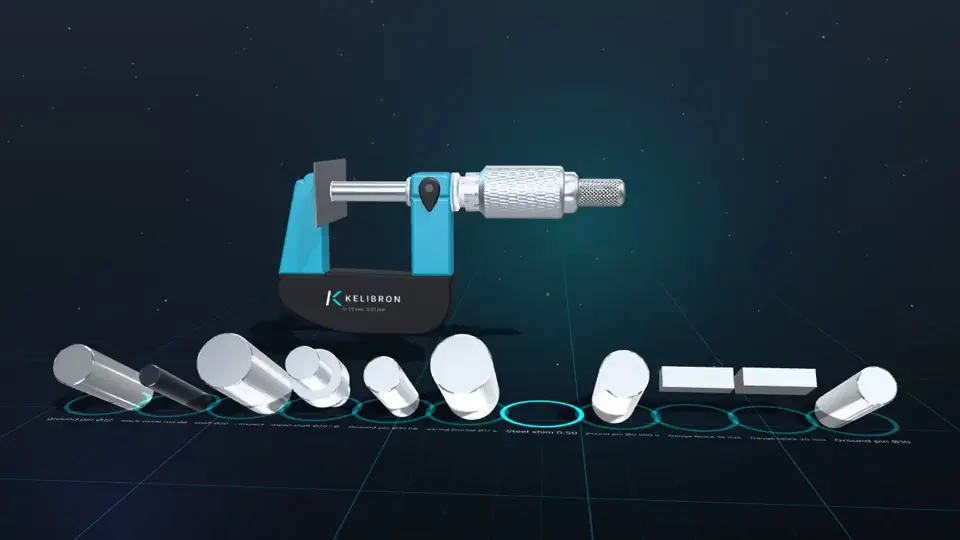 Reading instrumentsHow to use a micrometer: ratchet and thin partsThe last tightening is always with the ratchet: it slips at a set torque, so the measuring force stays nearly the same, within the range the instrument specifies, whoever turns it; turn it slowly.